missing translation for 'onlineSavingsMsg'
Learn More
Learn More



Invitrogen™ Fibronectin Monoclonal Antibody (FN-3), eBioscience™, Invitrogen™
Mouse Monoclonal Antibody
Marke: Invitrogen™ 14-9869-80
Dieser Artikel kann nicht zurückgegeben werden.
Rückgaberichtlinie anzeigen
Beschreibung
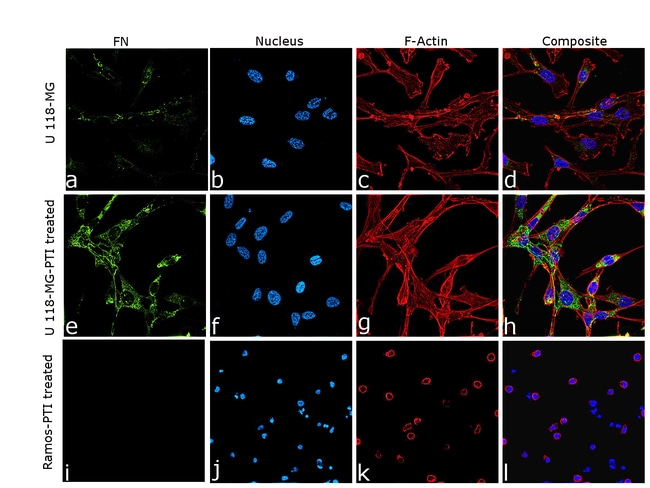
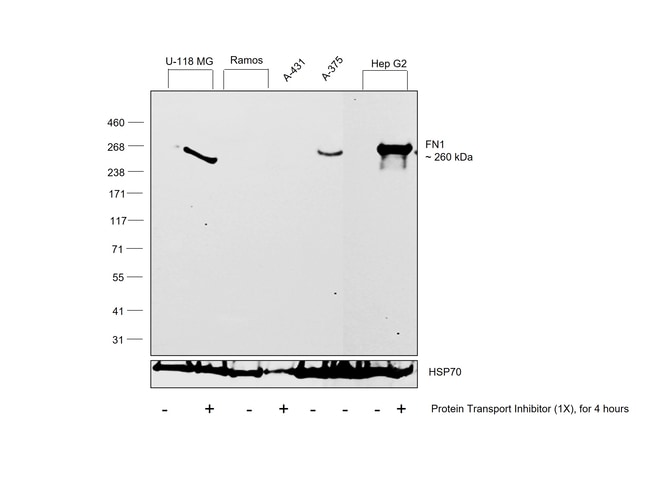
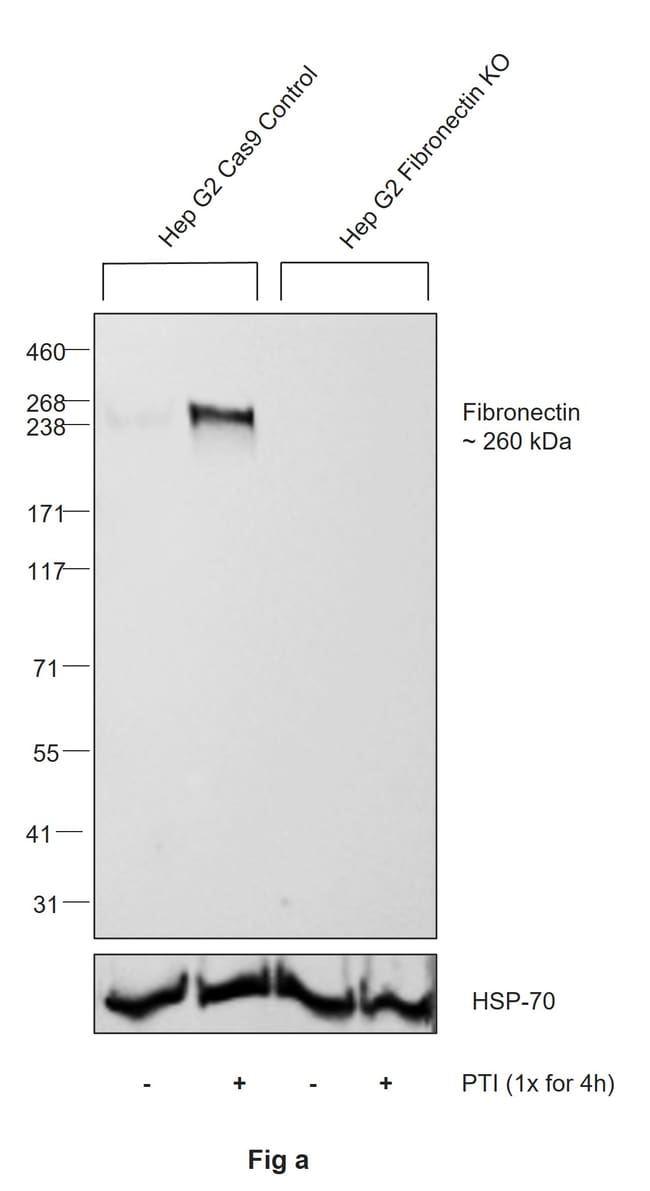
Description: The FN-3 monoclonal antibody recognizes human fibronectin, a component of the extracellular matrix. This high molecular weight protein (almost 400 kDa) exists as an extracellular and a soluble plasma form. Fibronectin functions in cell adhesion and migration via integrins present on the interacting cell. Fibronectin also associates with collagen, actin and fibrins. In malignancies, fibronectin protein levels can be altered. In lung carninomas, expression is decreased. The FN-3 antibody recognizes a determinant on human cellular but not plasma fibronectin; this recognition is not lost upon trypsin treatment. Furthermore, FN-3 antibody has been shown to crossreact to bovine fibronectin. Applications Reported: This FN-3 antibody has been reported for use in immunohistochemical staining of formalin-fixed paraffin embedded (FFPE) tissue sections and immunoblotting. Applications Tested: This FN-3 antibody has been tested by immunohistochemistry on FFPE human placenta (with IHC Antigen Retrieval Solution - Low pH (cat. 00-4955)) and can be used at less than or equal to 10 μg/mL. Is is recommended that the antibody be carefully titrated for optimal performance in the assay of interest. Purity: Greater than 90%, as determined by SDS-PAGE. Aggregation: Less than 10%, as determined by HPLC. Filtration: 0.2 μm post-manufacturing filtered.
Fibronectin is a disulfide-bonded dimer with a molecular weight range of 230-250 kDa. In the extracellular matrix of several connective tissues and vessels, fibronectin is present as an insoluble protein that is extensively cross-linked by interchain disulfide bonds forming high molecular mass polymers. Fibronectin is most abundant during embryonic development and tissue remodeling. Fibronectin is also present at high concentrations as a soluble plasma protein. Fibronectin is organized as a linear series of repeating modules which form domains for interaction with fibronectin itself, other matrix components (e.g. collagen and heparin) and receptors on cells (e.g. integrins). Fibronectin is present in a soluble dimeric form in plasma, and in a dimeric or multimeric form at the cell surface and in extracellular matrix. Fibronectin is involved in cell adhesion and migration processes including embryogenesis, wound healing, blood coagulation, host defense, and metastasis. Fibronectin has been implicated in carcinoma development in lung cancer. Further, Fibronectin expression is increased especially in non-small cell lung carcinoma. The adhesion of lung carcinoma cells to Fibronectin enhances tumorgenecity and confers resistance to apoptosis induced by standard chemotherapeutic agents. The gene encoding Fibronectin has three regions subject to alternative splicing, with the potential to produce 20 different transcript variants. However, the full-length nature of some Fibronectin variants has not been determined.
Spezifikation
| Fibronectin | |
| Monoclonal | |
| 0.5 mg/mL | |
| PBS with 0.09% sodium azide; pH 7.2 | |
| P02751 | |
| FN1 | |
| Affinity chromatography | |
| RUO | |
| 2335 | |
| 4°C | |
| Liquid |
| Immunohistochemistry (Paraffin), Western Blot, Immunocytochemistry | |
| FN-3 | |
| Unconjugated | |
| FN1 | |
| Anastellin; CIG; Cold insoluble globulin (CIG); Cold-insoluble globulin; cumulus cell-specific fibronectin 1 transcript; DKFZp686F10164; DKFZp686H0342; DKFZp686I1370; DKFZp686O13149; E330027I09; ED-B; embryo-specific fibronectin 1 transcript; ferritin L subunit; ferritin L-chain; FIBNEC; fibronectin; fibronectin 1; fibronectin ED-A- region; fibronectin ED-B+ region; fibronectin variable region; FINC; FN; FN1; fn-1; FNZ; GFND; GFND2; LETS; LOW QUALITY PROTEIN: fibronectin; Migration stimulating factor (MSF); migration-stimulating factor; MSF; Ugl-Y1; Ugl-Y2; Ugl-Y3 | |
| Mouse | |
| 25 μg | |
| Primary | |
| Human | |
| Antibody | |
| IgG1 |
Berichtigung von Produktinhalten
Bitte geben Sie uns Ihr Feedback zu den Produktinhalten, indem Sie das folgende Formular ausfüllen.
Name des Produkts
For Research Use Only.
Haben Sie Verbesserungsvorschläge?Übermitteln Sie eine inhaltliche Korrektur